
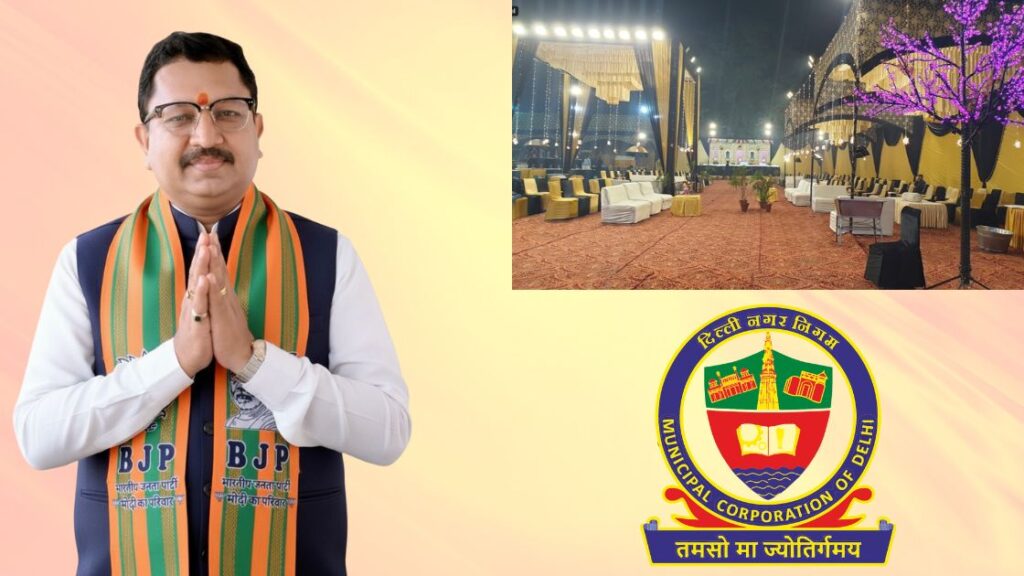
On 16 December 2025, Manoj Kumar Jain — Director of Bhagwan Mahavir Deshna Foundation and a nominated Municipal Councillor — submitted a carefully documented appeal to the Municipal Corporation of Delhi (MCD) seeking a substantial increase in penalties for violations of community-hall rules at Samudaye Bhawan Mahavir Vatika in Daryaganj. The letter raises an important governance and cultural-protection issue: repeated misuse of a public community hall named after a revered Jain saint, despite explicit terms that prohibit non-vegetarian food and alcohol on the premises.
Why this matters
Community halls are public resources entrusted to citizens for family and social functions. When such venues are managed on behalf of a faith or community — especially one like the Jain community whose principles include non-violence and strict dietary codes — maintaining the sanctity of the space is more than a contractual obligation. It is a matter of public sentiment and cultural respect.
Mr. Jain’s central concern, as outlined in his letter, is that the current enforcement mechanism is too weak. Under existing practice, a nominal security deposit is collected at the time of booking and forfeited if rules are violated. But the deposit is frequently treated by some users as a mere fee — a small, predictable penalty that does not deter repeat offenders. The result is systematic rule-breaking: non-vegetarian meals and alcohol being served within a hall whose usage conditions expressly forbid such actions. According to the appeal, this pattern of behaviour undermines the purpose of the hall and causes significant distress to the community associated with it.
What the MCD’s RTI revealed
To strengthen his case, Mr. Jain used India’s transparency mechanisms and secured an RTI (Right to Information) response from the MCD that lists incidents and details of violations at the Mahavir Vatika community hall. The RTI reply substantiates that repeated breaches have indeed occurred — demonstrating that the current deterrent (the nominal security deposit) has been insufficient to stop misuse. The RTI evidence forms an integral part of Mr. Jain’s request and highlights the need for a calibrated administrative response.
भगवान महावीर देशना फाउंडेशन (@bmdfofficial) के निदेशक मनोज कुमार जैन (@immanojjain) द्वारा एक अत्यंत सराहनीय और जिम्मेदार पहल की गई है।
— Manoj Kumar Jain (@immanojjain) December 16, 2025
समुदाय भवन महावीर वाटिका, दरियागंज में नियमों के बार-बार उल्लंघन—विशेष रूप से मांसाहार व मदिरा सेवन—को लेकर उन्होंने दिल्ली नगर निगम को औपचारिक… pic.twitter.com/uOzNh18Q6s
The remedy proposed
Given the frequency of violations and the social harm caused, the letter recommends increasing the penalty to a level that genuinely deters misuse. Specifically, Mr. Jain proposes raising the forfeitable penalty to INR 50,000 (Fifty Thousand Rupees) in cases where community hall rules — especially those proscribing non-vegetarian food and alcohol — are violated. In his words, a “higher penalty would act as a strong deterrent and prevent misuse of the community hall.” The appeal also includes a list of enclosures (RTI extracts and a case list), and it has been copied to senior officials and stakeholders for follow-up.
Why a higher penalty is justified
- Proportional deterrence: A deterrent must be meaningful. A nominal deposit treated as a routine cost becomes an invitation for deliberate contravention. Increasing the penalty restores proportionality and incentivizes compliance.
- Protecting community sentiments: The Mahavir Vatika bears the name of Bhagwan Mahavir — a figure whose principles are central to Jain identity. Repeated disrespect at such a venue harms religious sentiments and social harmony.
- Administrative fairness: Regular users and lawful applicants—a large majority—comply with rules and expect fair enforcement. Holding violators to account sustains trust in public administration.
- Rule clarity and enforcement: The RTI response shows documented violations; hence, the problem is verifiable. A higher, clearly spelled-out penalty implemented with consistent monitoring will make enforcement practicable and credible.
Next steps recommended (practical and administrative)
• Immediate ordinance to revise penalty: Issue an administrative order to revise the penalty structure for community halls, setting the higher forfeiture amount where prescribed rules are wilfully violated.
• Public notice & transparency: Mandate visible posting of usage rules, penalties, and a QR-linked digital grievance form at the venue and on relevant MCD web pages.
• Audit & accountability: Direct community-services and enforcement wings to audit repeat offenders and prepare a compliance report every quarter. The RTI list can serve as a baseline for scrutiny.
• Appeals & due process: While strengthening penalties, ensure a fair appeal mechanism for hall users so that genuine misunderstandings are resolved without undue hardship.
• Awareness & registration: Encourage community groups to promote awareness and include explicit declarations in booking agreements accompanied by photographic ID verification at the time of entry.
Conclusion
Mr. Manoj Kumar Jain’s letter is not merely an advocacy note; it is a policy intervention grounded in evidence (via the RTI) and framed around the twin goals of administrative accountability and social respect. Strengthening penalties — together with transparent enforcement and a fair appeals process — is a reasonable step that balances deterrence with due process. The MCD’s considered response will be an important test of civic governance: can administrative rules be tightened to protect public values while ensuring procedural fairness?
For civic administrators and community leaders alike, this case provides an instructive example of how local grievances, when documented and escalated responsibly, can prompt institutional reform. The expectation now is for MCD to act decisively on the documented evidence and restore the sanctity and intended use of Samudaye Bhawan Mahavir Vatika for everyone it serves.
— Written by a supporter of community governance; based on the letter & RTI documents submitted by Manoj Kumar Jain (Bhagwan Mahavir Deshna Foundation / Nominated MCD Councillor).
 0
0
 20
20
 20
20
